Mauritanian State Security Directorate
Guantanamo DiaryThe Mauritanian State Security Directorate is the Mauritanian intelligence and security authority that questioned Mohamedou Ould Slahi during two periods of detention and held him before his November 2001 transfer to Jordan. In his account, it operated both as an investigative body and as a local custodian within a cross-border detention process shaped by the United States. Its importance lies not only in what its officials did, but in the way custody, information, and responsibility were divided among Mauritanian and foreign authorities.
Identity and Place in the Security Apparatus
Slahi identifies the Directorate through its director and the officials who worked around him: an assistant, a recorder, an inspector, and guards. The evidence does not provide a formal organizational chart, but it depicts a hierarchy in which the director conducted questioning, staff searched and reviewed documents, and other officers controlled the prisoner’s movements. Slahi understood Mauritanian intelligence to hold greater law-enforcement authority than the airport police, a distinction that shaped his expectations when he was brought back into the country.
The Directorate’s role was connected to, but not identical with, the wider Mauritanian government. Slahi’s account attributes major decisions about his detention and transfer to senior state officials, while describing the Directorate as the body whose director and personnel dealt with him directly. That distinction matters: the narrative presents an institutional chain of command, not evidence that every action was decided by the same official or office.
Questioning after the 2000 Handover
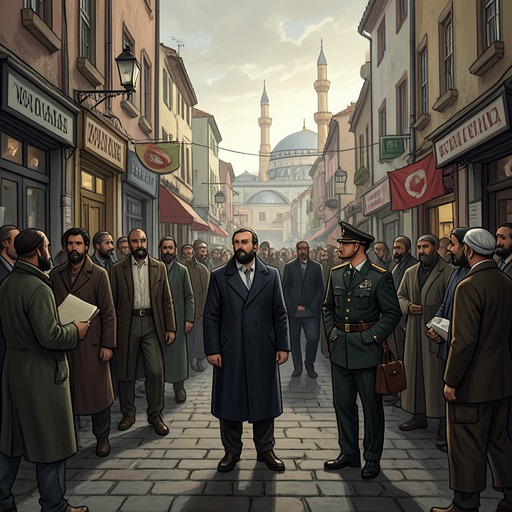
After Slahi was handed over to Mauritanian authorities in 2000, the Directorate questioned him about the Millennium Plot. At the airport, an inspector and another man waited for him; the inspector then took him by car to a security police building. The trip lasted about ten minutes. Slahi describes the building as poorly maintained, with a dirty floor and walls, a damaged toilet, and openings between rooms. The account places his first interrogation in the Directorate director’s large, furnished office, where the director, an assistant, and a recorder were present.
The questioning involved a close examination of Slahi’s belongings and papers. Officials initially spoke among themselves rather than to him, set aside documents they considered interesting, and later asked about individual words in those papers. The director then warned Slahi that he should tell the whole truth; Slahi said he would. The scene portrays the Directorate’s investigative method as document-focused and personally controlled by its director, although the account does not specify a formal procedure or identify the evidence the officers considered significant.
This first period ended with Slahi being told he was free to go and receiving his belongings. The passage also describes a disagreement between the Mauritanian and United States governments over whether he should be kept: in Slahi’s telling, Mauritanian officials did not want him, while the United States pressed for his continued detention. The episode establishes an early pattern in which the Directorate’s direct custody of Slahi took place amid pressure from a foreign government, rather than in isolation from it.
Renewed Arrest and Secrecy
Slahi was arrested again in 2001 after returning voluntarily to police headquarters. He had recently completed work connected with the Presidential Palace, and he expected to return home after questioning. Instead, he disappeared from his family’s view. Slahi recounts that the United States had asked Mauritania’s president to hold him, after which the president directed the national security leadership and the inspector to detain him. He presents this account as his understanding of the chain of orders, not as a fully documented record of each official’s actions.
During this renewed detention, the inspector took Slahi’s phone and gave him reassurance that Slahi later characterized as false. Slahi had erased his contact list before surrendering the phone, partly because he feared that ordinary business contacts in Mauritania and Germany might be treated as suspicious. He describes the arrest as the outcome of requests passed between the United States and Mauritanian leaders, with the Directorate’s personnel carrying out the detention on the ground. His account also stresses that information was limited even among officials: the inspector, like Slahi, did not know the full purpose of the arrest, while senior decision-makers were away or still considering what to do.
Custody and Transfer to Jordan
Slahi says that he spent seven days in Mauritanian custody without a family visit and that his family was not told where he was. He became seriously ill and had difficulty eating and standing; a doctor was called to examine him. On November 28, 2001, Mauritanian Independence Day, he was told he would be sent to Jordan. The date gave the transfer a political significance in his account: he contrasts the public commemoration of national independence with the government’s decision to surrender one of its citizens abroad. He states that the transfer violated Mauritania’s constitutional prohibition on extraditing its citizens, while presenting the choice as a matter for the government, not solely for the Directorate.
The director informed Slahi of the destination in private, after guards had left and the recorder had fallen asleep. Slahi’s account therefore places the Directorate at the immediate point of disclosure and custody, but describes the transfer as part of a broader arrangement involving Mauritania, the United States, and Jordan. The subsequent secret movement through Jordan, Bagram, and Guantánamo belonged to that wider detention chain; the Directorate’s documented part in the narrative is the arrest, questioning, and holding in Mauritania before Slahi was sent abroad.
Accountability and Limits of the Record
The family’s understanding of Slahi’s whereabouts diverged sharply from the reality he describes. For nearly a year, relatives believed he remained in Mauritanian custody; his older brother Hamoud visited a security prison with clean clothes and money for meals. In fact, according to the account, a CIA rendition flight had taken Slahi to Jordan about a week after he turned himself in. The prison officials continued accepting money while giving the family no notice of his absence. The text does not establish that these prison officials were themselves Directorate employees, so their conduct cannot be assigned to the Directorate as an organization on this evidence alone.
The account’s institutional picture is forceful but bounded. The Directorate’s officers are visible in the interrogation room, the security building, and the handover to foreign custody; the senior deliberations and division of responsibility are less fully documented. The manuscript’s editor explains that annotations concerning redactions draw on contextual reading and public records, but are not attempts to reconstruct censored text or disclose classified material. Read with that caution, the Directorate emerges as a local instrument of questioning and detention within a transnational system, while the precise scope of its knowledge and authority remains partly obscured.